Lula Landry's death
The Cuckoo's CallingLula Landry’s death at Kentigern Gardens is the novel’s central disputed event: a fall that the police classified as suicide, but that Cormoran Strike’s investigation gradually reconstructs as murder. Its significance lies not only in the cause of death, but in the collision between a private fatal event and a public spectacle, and in the small physical traces that challenge the certainty of the first account.
Discovery and Public Spectacle
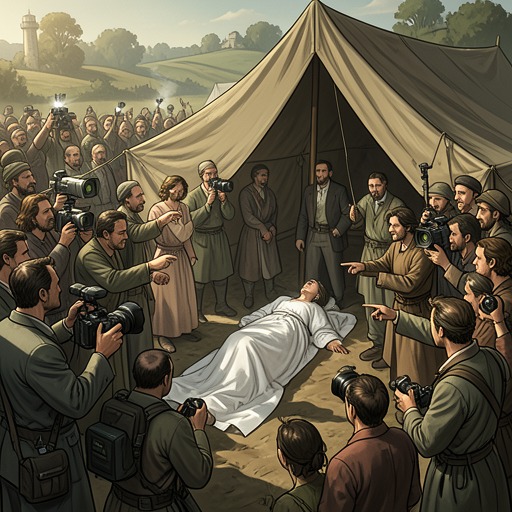
The death is introduced through its aftermath on a snowy Mayfair street. Photographers crowd behind police barriers, aiming at the canvas tent, the red-brick apartment building, and the upper balcony from which Lula fell. Satellite vans, television crews, journalists, and passers-by turn the scene into a national news event even as forensic officers work inside the taped-off entrance. Members of the public raise their phones to take pictures; some have come deliberately to watch, while others pause on their way to work. The street’s orderly façades and clipped topiary are set against the commotion gathered around the concealed body.
Inside the tent, officials prepare to move Lula’s body. Her sequined top catches slight changes in the light, while snow continues to fall outside. The scene’s visual details make the death both physically present and difficult for the public to apprehend directly: the body is screened from view, yet cameras multiply images of the building and balcony. The press does not merely report the event; its attention becomes part of what the event means.
Within hours, the story has displaced news of politics, wars, and disasters. Coverage circulates a few striking facts: Lula’s public row with her famous boyfriend, her journey home alone, reports of shouting, and the final fall. Her boyfriend, Evan Duffield, enters rehab, while those who had been with her on the previous evening face relentless press attention. A woman who claimed to have heard a second argument briefly becomes a media figure herself, appearing in smaller photographs beside images of Lula. When that witness is shown to have lied, she retreats into rehab and the public’s attention shifts again. The episode establishes how rapidly an uncertain account can harden into celebrity news—and how quickly the story can change when a prominent witness is discredited.
Suicide Verdict and Competing Accounts
The initial official conclusion is suicide. When John Bristow hires Strike, he says that people believe his sister killed herself but that he does not. Strike recalls how thoroughly the death has already been covered: the repeated television images have made the public unusually informed, and unusually opinionated, before the investigation begins. Bristow argues that the detective in charge settled on suicide because Lula was taking lithium, overlooking matters that had been noticed and discussed online.
The police case is not wholly without supporting observations. Eric Wardle tells Strike that even if investigators had identified two men seen running from the building, their account would at most have supported the view that Lula jumped; there was no unexplained DNA in her flat, and no evidence that an unauthorized person had been inside. This is an important limit on the early case: suspicious questions and an unsettling public narrative do not, by themselves, establish a killer’s presence.
Online discussion nevertheless keeps the uncertainty alive. A fan account lists questions about who might have called off the paparazzi before the fall, why two men with covered faces were seen running from Lula’s flat at about two in the morning, and why she wore a different outfit from the one in which she had returned home. The questions are not proof, but they direct Strike’s attention toward gaps in the settled account, including the timing, the visitors, and the change of clothes.
Physical Evidence and Unresolved Witnessing
The autopsy record states that Lula died on impact with the road from a broken neck and internal bleeding. It also records bruising on her upper arms and notes that she was wearing only one shoe. Photographs confirm that she had changed after returning from the nightclub: rather than the dress in which she had been photographed entering the building, she wore a sequined top and trousers when she fell. These findings establish circumstances that need explanation, but do not by themselves determine whether she jumped or was pushed.
Strike’s review of the case file makes Tansy Bestigui’s shifting account newly important. Tansy first described going to the bathroom from the bedroom, then added that she had opened the sitting-room window; she maintained that her husband, Freddie Bestigui, had been asleep throughout. Freddie said he was woken by his wife’s screams and saw her run through the sitting room in her underwear. The police found cocaine in the flat, including half a line on the bath’s marble rim and a small bag in a bathroom cabinet. Freddie acknowledged knowing about Tansy’s habitual drug use, though he said he did not know she had a supply there that night. The police treated her account as a consequence of cocaine use, but Strike remained troubled by her insistence that Freddie had been in bed and asleep when Lula fell. He recalled Tansy shielding her face as he pressed her on the point and judged that the Bestiguis’ precise positions at the time had not been established.
A further inconsistency emerges from the account of Derrick Wilson, the building’s security guard. After hearing the Bestiguis in the lobby, Wilson says that he took the master key from the back room and ran upstairs to unlock Lula’s flat. During a later reconstruction with Strike and Robin Ellacott, he retraces the order in which he searched the rooms. On the stairs he suddenly remembers slipping backwards on water. The detail changes the meaning of an apparently ordinary trace: it connects the sequence of events in the building to a substance that should not have been there and gives Strike a reason to re-examine the route and timing of the search.
At the penthouse balcony, Strike imagines the fall as the culmination of a violent confrontation rather than a deliberate jump. His reconstruction places Lula in the outfit she had put on to meet an expected visitor and pictures an attacker forcing her over the balcony. The narrative marks this as a developing hypothesis, not yet a proved account: Strike feels the truth coming into focus, but knows that he still lacks proof. That distinction governs the investigation. The reconstruction gives disconnected clues a possible order, while the need for corroboration prevents suspicion from becoming certainty.
Reconstruction and Revealed Cause
The eventual reconstruction explains why several small details mattered together. According to Strike’s account to John Bristow, the paparazzi had left the street after being tipped off by Lula’s regular driver, a man interested in cultivating press contacts. Once the street was empty, Bristow put on Deeby Macc’s hoodie and carried white roses from Flat Two toward his sister’s apartment. He dried the ends of the flowers, but not completely, and left the door ajar. A few drops of water remained on the stairs; Wilson later slipped on them. At Lula’s door, the roses presented an apparently welcome image to someone waiting for a visitor. Seeing them through the peephole, Lula opened the door in excitement, and Bristow was admitted.
The reconstruction turns separate uncertainties into a causal sequence: the cleared street reduced the chance of observation; the hoodie concealed Bristow’s identity; the flowers provided an explanation for his unexpected arrival; and the water drops later became a trace on Wilson’s route. The details do not merely decorate the account. They explain how a visitor could reach Lula while appearing to be someone she wanted to see, and why the guard’s fall on the stairs registered as a significant piece of evidence only after the scene was revisited.
The death thus changes meaning as the investigation changes scale. At first, cameras focus on the balcony and the public debates whether a famous young woman chose to die. Strike’s inquiry turns from the spectacle to disputed timings, witness statements, clothes, footwear, the positions of people in the neighbouring flat, and water on a stair. The final account identifies Lula’s fall as murder rather than suicide and exposes the apparent certainty of the original verdict as a conclusion reached before the evidence had been fully understood. The event’s enduring force comes from that reversal: a death made public by celebrity is finally clarified through details too small to command the public’s attention on their own.